A structured system for communication, cognition, and generative intelligence
Architecture of Human Coherence
Modeling how human beings move from perception to structured intelligence and into coherent, generative action.
The architecture mapped
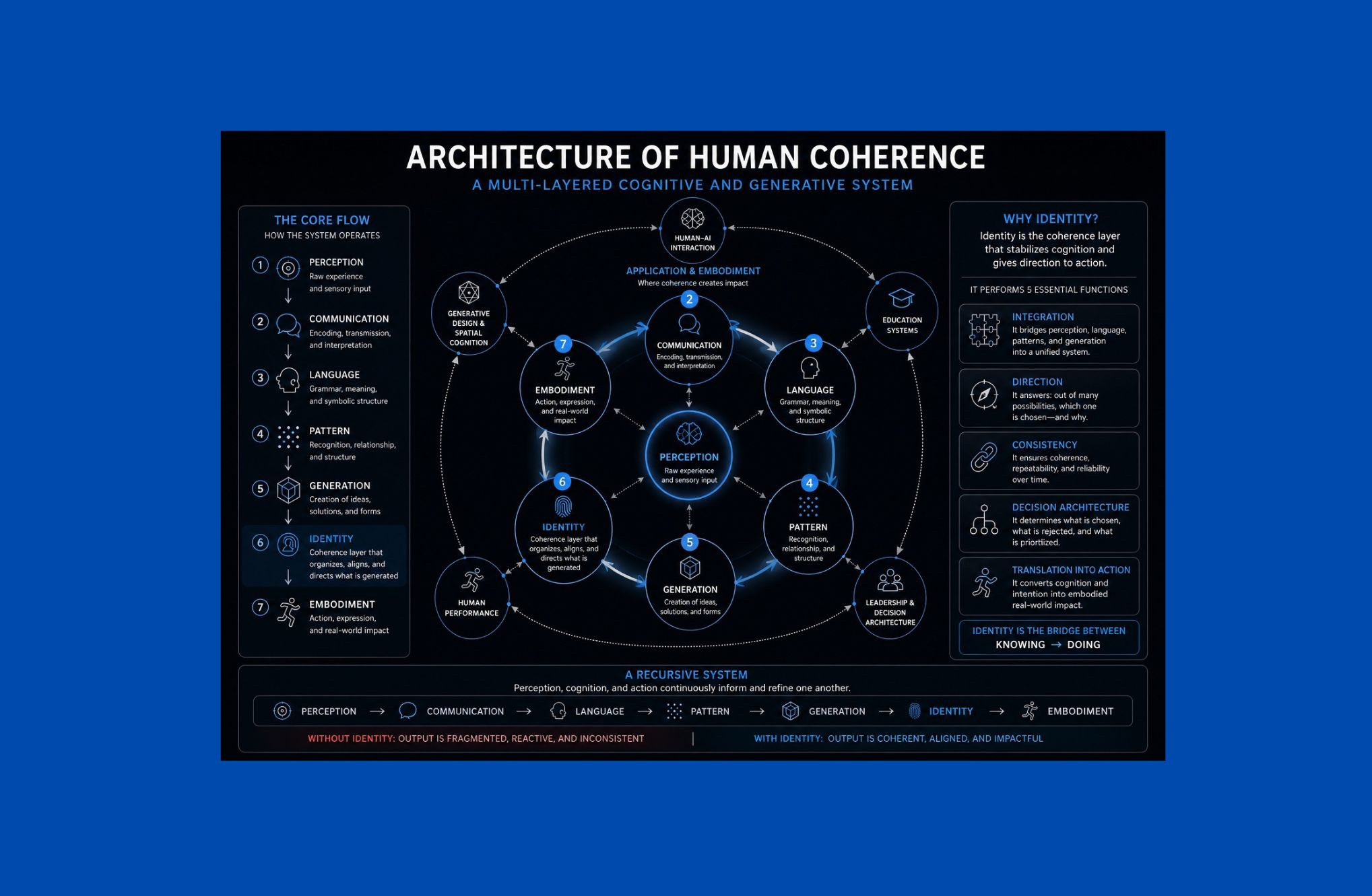
A multi-layered system connecting perception, cognition, generation, and embodied action.
Modeling how human beings move from perception to structured intelligence and into coherent, generative action.

The System
This work presents a structured architecture composed of interdependent layers. Each layer builds upon the previous, forming a continuous pathway from perception to embodiment.

The encoding, transmission, and interpretation of meaning
Communication Architecture
Human-AI interaction, communication systems, organizational alignmentDefines how meaning is structured, transmitted, and interpreted.

The formation of thought through language
Grammar → identity and naming
Logic → reasoning and structure
Rhetoric → expression and influence
Language & Cognitive Structure
Education systems, reasoning frameworks, cognitive modeling

Understanding reality through number, pattern, and relationship
Mathematical & Pattern Perception
Systems thinking, spatial reasoning, pattern recognition

The emergence of form through iterative relational processes
Generative Geometry & Form Emergence
Generative design, computational modeling, spatial cognition

Decision-making, identity coherence, and value alignment
Behavioral & Identity Architecture
Leadership, performance systems, human behavior

Translating cognition into lived, embodied experience
Embodied Integration
Human performance, resilience, mind-body integration

Perception → Communication → Language → Pattern → Generation → Identity → Embodiment
System Flow
A recursive architecture in which each layer continuously informs and refines the others

This architecture is designed for application across multiple domains:
Human–AI Interaction
Education & Learning Systems
Leadership & Decision Architecture
Generative Design & Spatial Cognition
Human Performance & Embodiment
APPLICATION
This architecture provides a structured pathway from fragmented knowledge toward integrated intelligence and coherent action.

Research & Collaboration
Collaboration
This work is actively being explored in relation to:
cognitive architecture and intelligence systems
generative models of structure and meaning
communication and knowledge system design
human-centered and interdisciplinary innovationOpen to research collaboration, applied system design, and interdisciplinary exploration.

Research & Collaboration
A formal articulation of this work is available for research dialogue and institutional engagement.
Supporting Research Framework for the Architecture of Human Coherence
The Architecture of Human Coherence is supported by an expanding body of interdisciplinary research examining how human beings develop through lived experience, language, number, form, relationship, participation, identity, and purpose. The framework presented below illustrates the developmental architecture emerging from this ongoing research program and the publications that explore each component in greater depth.
Research Papers
These papers establish the theoretical foundations of the Architecture of Human Coherence and are published through Zenodo with permanent DOI identifiers.
Developmental Architecture
The Architecture Map illustrates the developmental sequence through which coherence emerges—from lived experience through language, pattern recognition, embodied practice, identity formation, and ultimately sovereign participation in life.
Publication Series
The books expand and apply the research through historical, philosophical, educational, and practical perspectives, providing multiple pathways into the Architecture of Human Coherence.
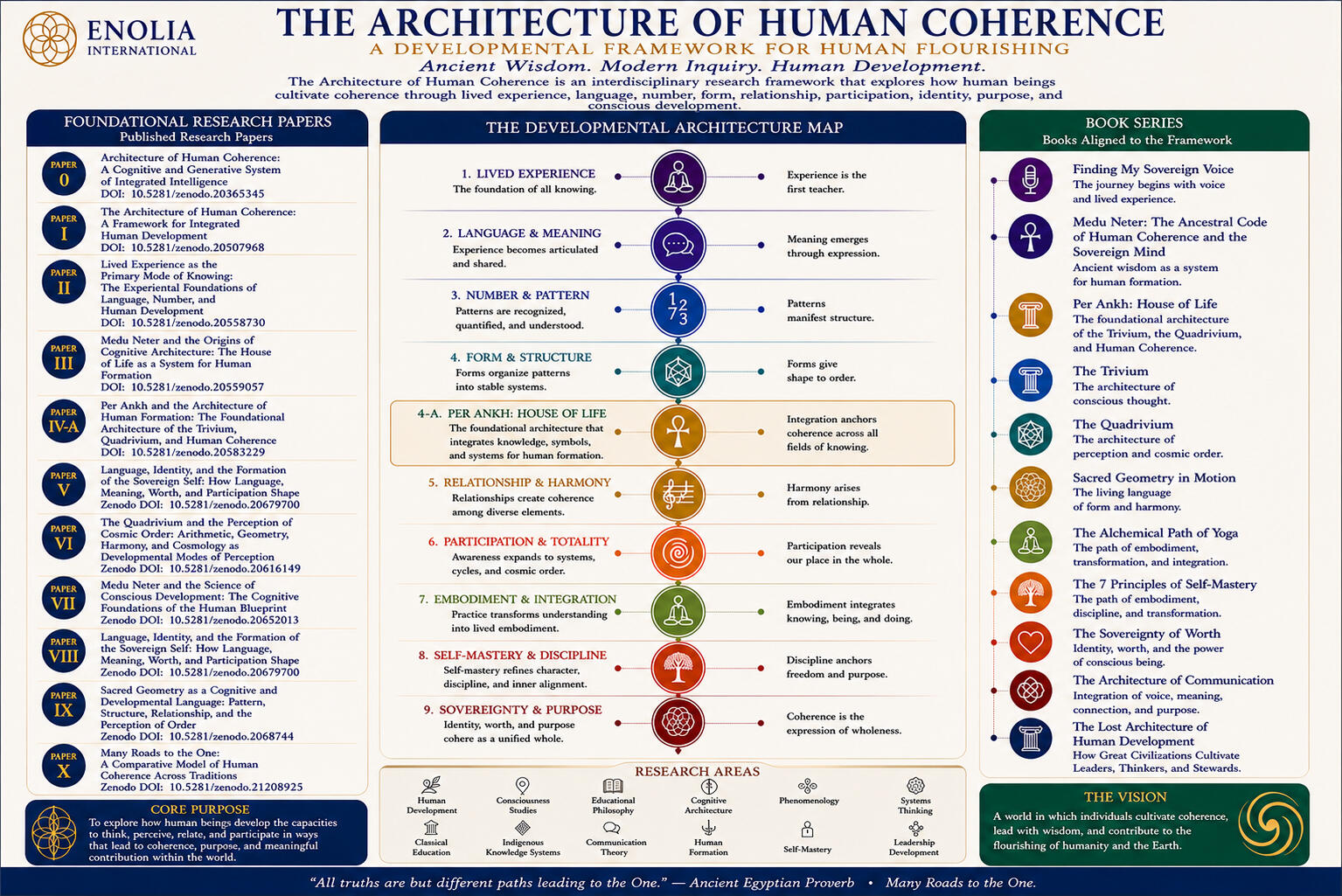
The Architecture of Human Coherence is an evolving interdisciplinary research program. As new discoveries emerge, additional papers, models, and publications will extend and refine this developmental architecture while remaining grounded in the central question: How do human beings develop into coherent, responsible, and flourishing participants in life?
APPLICATIONs of the Architecture
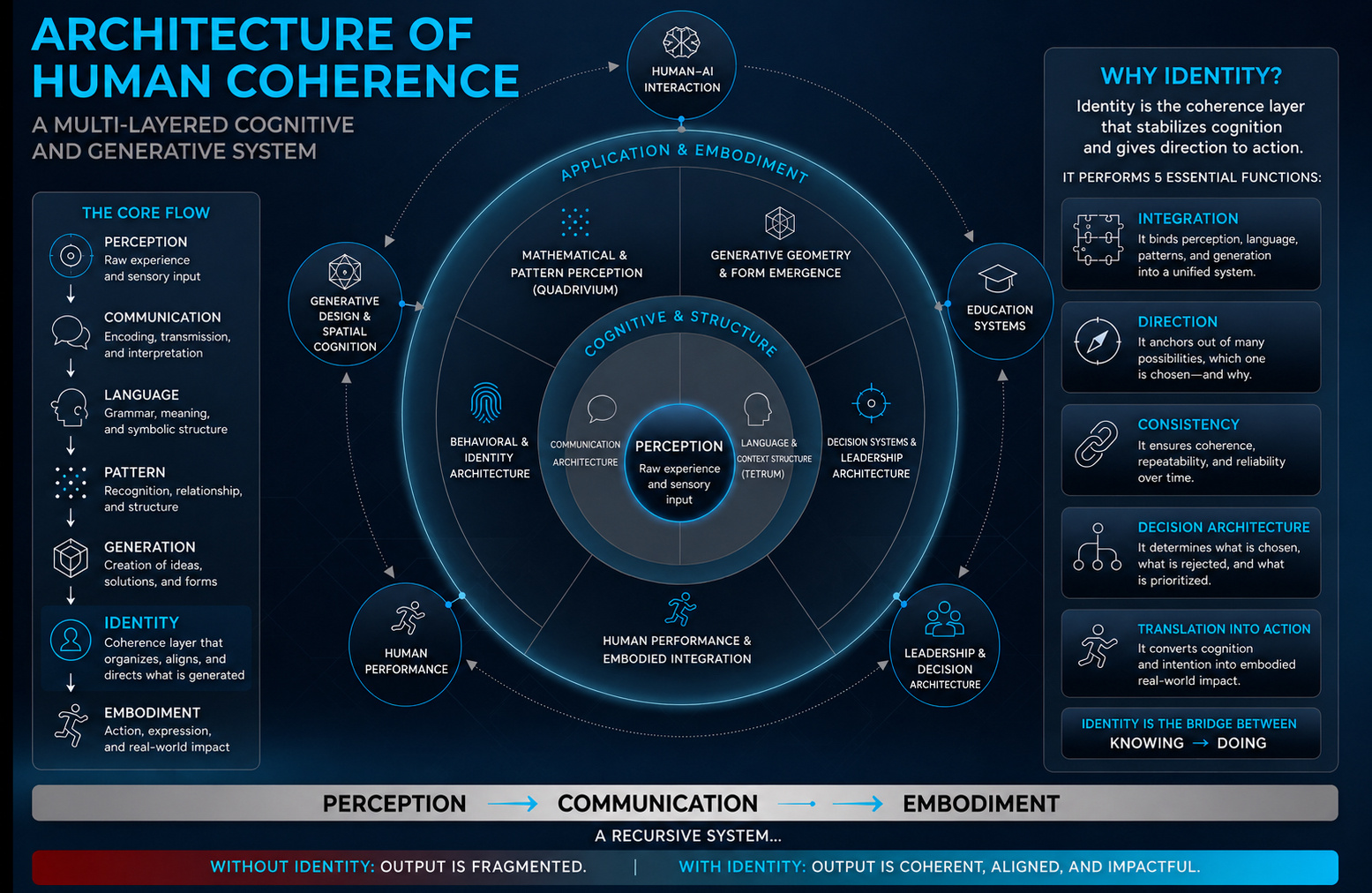
Translating cognitive architecture into real-world systems, design, and human performance
This work is designed not only as a theoretical framework, but as an applied system for improving how human beings learn, think, decide, and create across multiple domains.

A System Designed for Application
This architecture provides a structured pathway from perception to action, enabling the design of systems that align cognition, communication, pattern recognition, and behavior.
It is applicable across domains where human intelligence, decision-making, and system design intersect.
Translating cognitive architecture into real-world systems, design, and human performance
Human–AI Interaction
Improving how humans interface with intelligent systems
This framework models how meaning is formed, structured, and interpreted—offering a foundation for more effective interaction between human cognition and machine systems.
AI interface design
prompt architecture and communication systems
human-centered AI alignment
cognitive clarity in human-machine interaction
Education & Learning Systems
Redesigning how humans learn and structure knowledge
By integrating language, pattern recognition, and embodied understanding, this system provides a multi-layered approach to learning that moves beyond memorization into structured comprehension.
curriculum design
accelerated learning frameworks
interdisciplinary education models
cognitive development systems
Human Performance & Embodied Systems
Integrating cognition into lived, physical experience
This domain ensures that knowledge is not abstract, but embodied—linking mental models with physical performance, resilience, and adaptability.
performance optimization
resilience and stress systems
mind-body integration
sustained high-functioning environments
Generative Design & Spatial Cognition
Understanding how structure emerges through pattern and geometry
Using geometric construction as a generative process, this framework models how complex systems arise from simple relational rules.
generative design systems
computational modeling
spatial reasoning development
visual learning environments
Leadership & Decision Architecture
Structuring how individuals and organizations make decisions
This layer translates cognition into action—aligning identity, values, and decision-making processes into coherent leadership systems.
executive decision frameworks
leadership development systems
organizational alignment models
high-performance environments

CROSS-DOMAIN IMPACT
Integrated Impact
What distinguishes this architecture is not its application in a single domain, but its ability to operate across domains simultaneously.
It connects:
communication with cognition
cognition with pattern recognition
pattern with generative structure
structure with decision-making
decision-making with embodied actionThis creates systems that are not fragmented—but coherent, adaptive, and scalable.
ENGAGEMENT
Research & Collaboration
This work is actively being explored in relation to:
cognitive architecture and intelligence systems
human–AI interaction and alignment
generative models of structure and meaning
education and knowledge system design
leadership and performance systemsOpen to research dialogue, applied system development, and interdisciplinary collaboration.
Selected frameworks and publications available for deeper study.
Architecture of Human Coherence
A Cognitive and Generative System of Integrated Intelligence
A formal articulation of the system presented on this site.
Supporting Research Paper Links
- Paper IV - Per Ankh and the Architecture of Human Formation: The Foundational Architecture of the Trivium, Quadrivium, and Human Coherence
- Link
- Paper V - The Trivium as a Living Architecture of Conscious Thought: Grammar, Logic, and Rhetoric as Developmental Operations of Consciousness
- Link
- Paper VI - The Quadrivium and the Perception of Cosmic Order: Arithmetic, Geometry, Harmony, and Cosmology as Developmental Modes of Perception
- Link
- Paper VII- The Quadrivium and the Perception of Cosmic Order: Arithmetic, Geometry, Harmony, and Cosmology as Developmental Modes of Perception
- Link
- Paper VII- Language, Identity, and the Formation of the Sovereign Self: How Language, Meaning, Worth, and Participation Shape Coherent Identity
- Link
- Paper IX- Sacred Geometry as a Cognitive and Developmental Language: Pattern, Structure, Relationship, and the Perception of Order
- Link
- Paper XII - The Architecture of Inquiry: Methodological Foundations for the Architecture of Human Coherence
- Link
- Paper XIII - The Architecture of Correspondence: Saint-Yves d'Alveydre's Archeometer as an Architecture of Symbolic Inquiry
- Link
- Paper XIV - The Architecture of Human Formation: The Developmental Foundations of Human Coherence
- Link
- Paper XVII - The Medicine Wheel as an Architecture of Human Formation An Indigenous Architecture of Human Coherence
- Link
- Paper XVIII - Lived Experience, Temporal Consciousness, and the Formation of the Conscious Human Being: Husserl, Gurdjieff, Indigenous Knowledge Traditions, and the Architecture of Human Formation
- Link
- Paper XX - Traditional Japanese Civilization as an Architecture of Human Formation: A Case Study in the Formation of the Coherent Human Being.
- Link
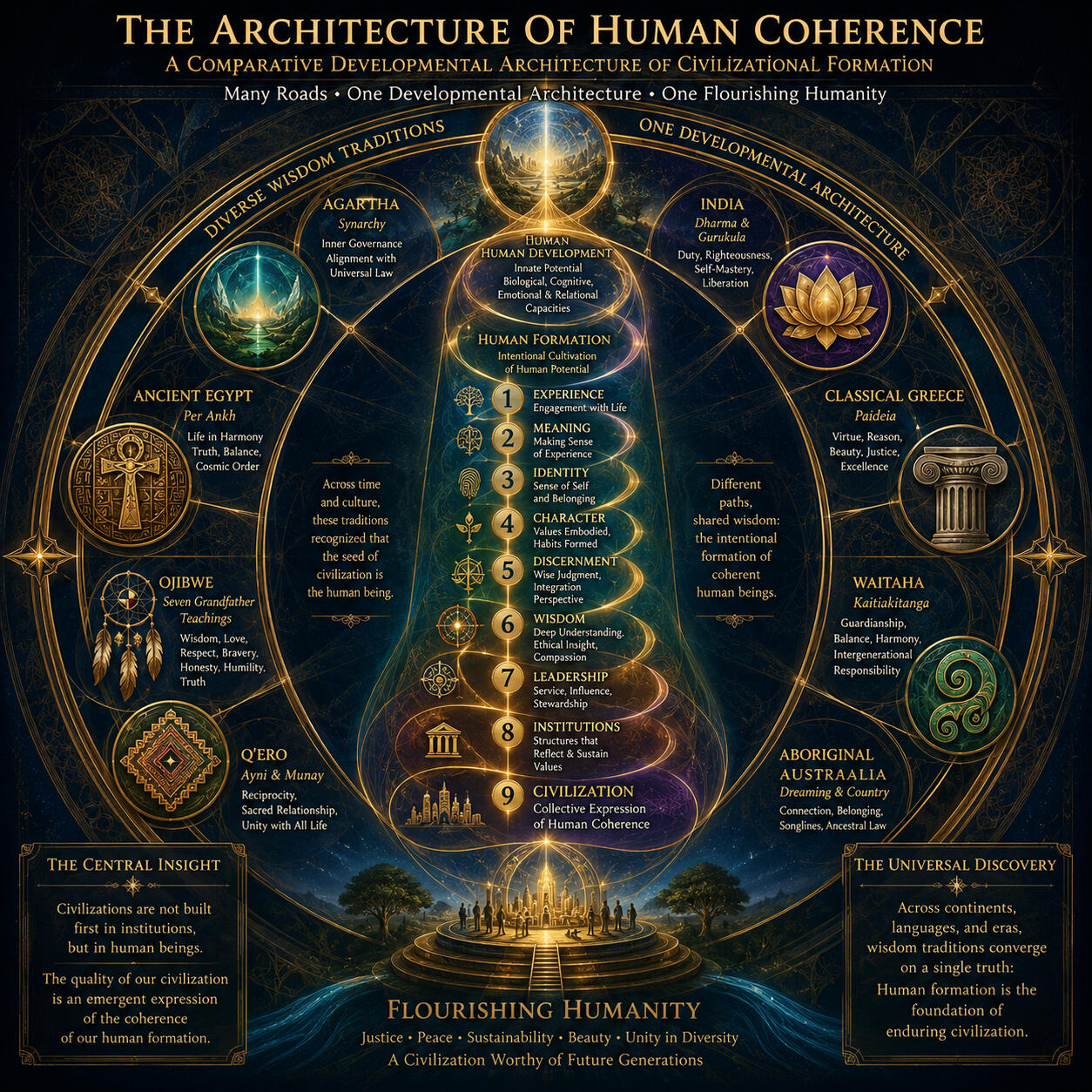
The Architecture of Human Coherence: A Comparative Developmental Theory of Civilizational Formation - Research paper XI
Comparative Developmental Architecture of Civilizational Formation. This conceptual model illustrates the central thesis of the Architecture of Human Coherence: despite profound differences in culture, history, and worldview, diverse wisdom traditions converge upon a shared developmental insight—that coherent civilizations emerge through coherent human formation. The model synthesizes these recurring principles into an original developmental architecture in which human development progresses through experience, meaning, identity, character, discernment, wisdom, leadership, institutions, and ultimately the emergence of flourishing civilization.
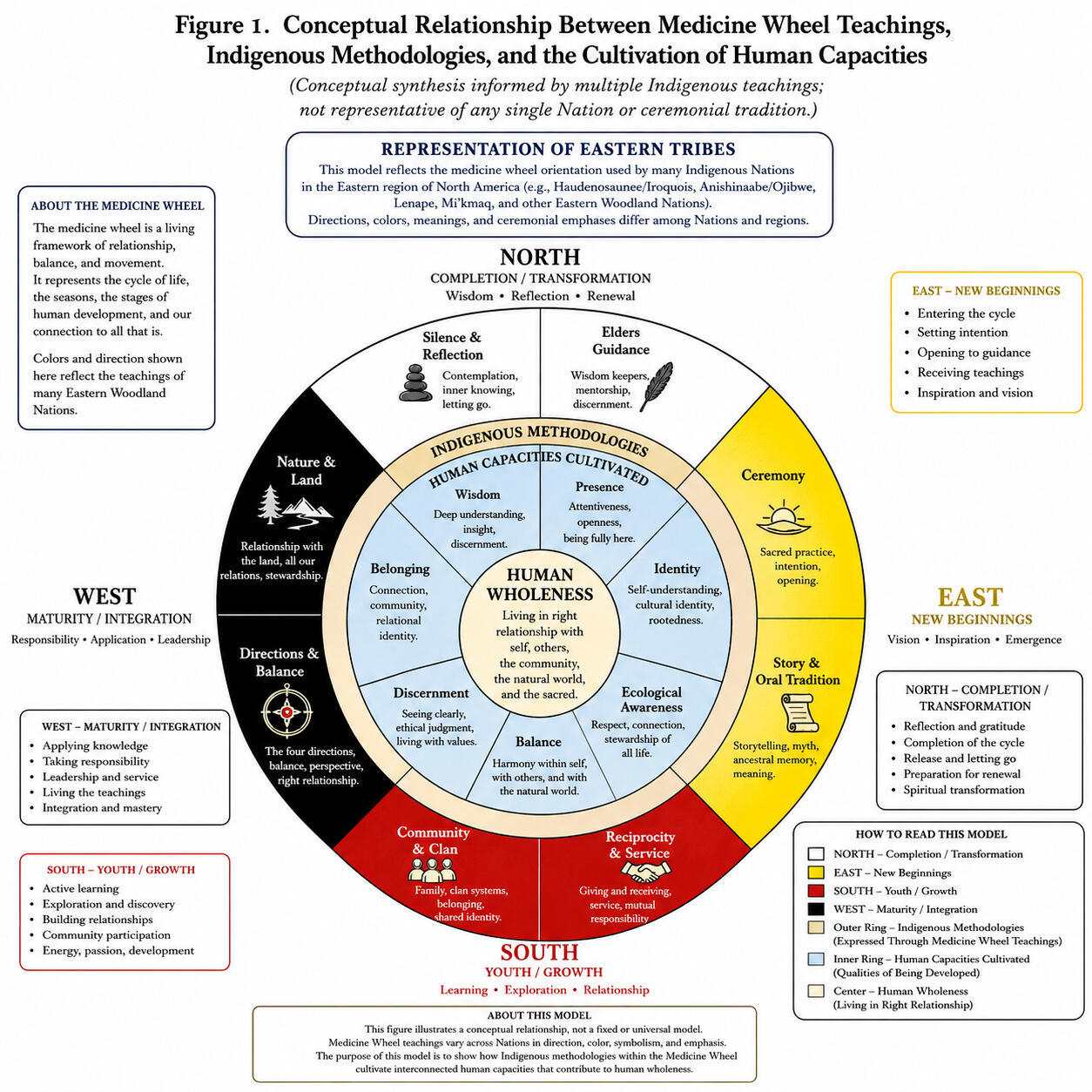
Cultivating the Human Being: Indigenous Methodologies and the Development of Human Capacities - Research paper XV
Conceptual Relationship Between Medicine Wheel Teachings, Indigenous Methodologies, and the Cultivation of Human Capacities - Research Paper XV
This conceptual model illustrates how Indigenous methodologies—including ceremony, storytelling, Elder guidance, relationship with the land, community, reciprocity, and reflective practice—collectively cultivate the human capacities that contribute to wisdom, belonging, discernment, ecological awareness, balance, identity, and ultimately human wholeness. Rather than representing any single Indigenous Nation or ceremonial tradition, the framework is a conceptual synthesis informed by decades of participatory learning with Indigenous Elders and interdisciplinary scholarship. It proposes that education is not solely the transmission of knowledge, but the intentional cultivation of the human being through lived relationship, participation, and lifelong development.
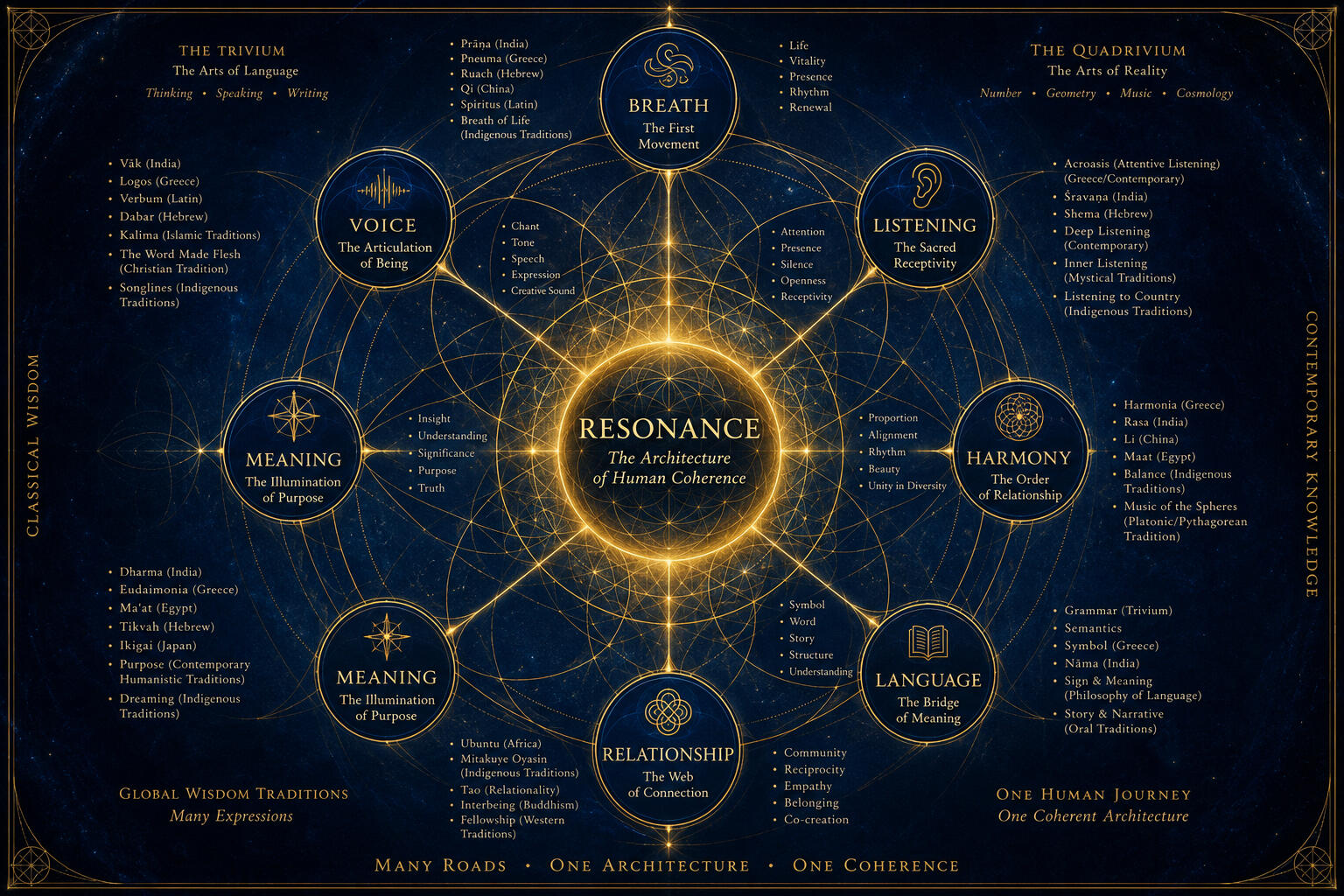
The Architecture of Resonance: Voice, Harmony, and the Formation of Human Coherence Research Paper XVI - Research paper XVI - A CONCEPTUAL MAP OF DEVELOPMENTAL RELATIONSHIPS
This conceptual map illustrates the architectural methodology employed throughout this study. Rather than comparing philosophical, educational, or cultural traditions by doctrine or historical lineage, the framework compares their developmental functions in the formation of human coherence. Resonance is presented as the organizing principle through which breath, voice, listening, harmony, language, relationship, and meaning participate in the progressive formation of the whole person. The map is intended as a heuristic model that visualizes relationships rather than a comprehensive taxonomy of traditions.
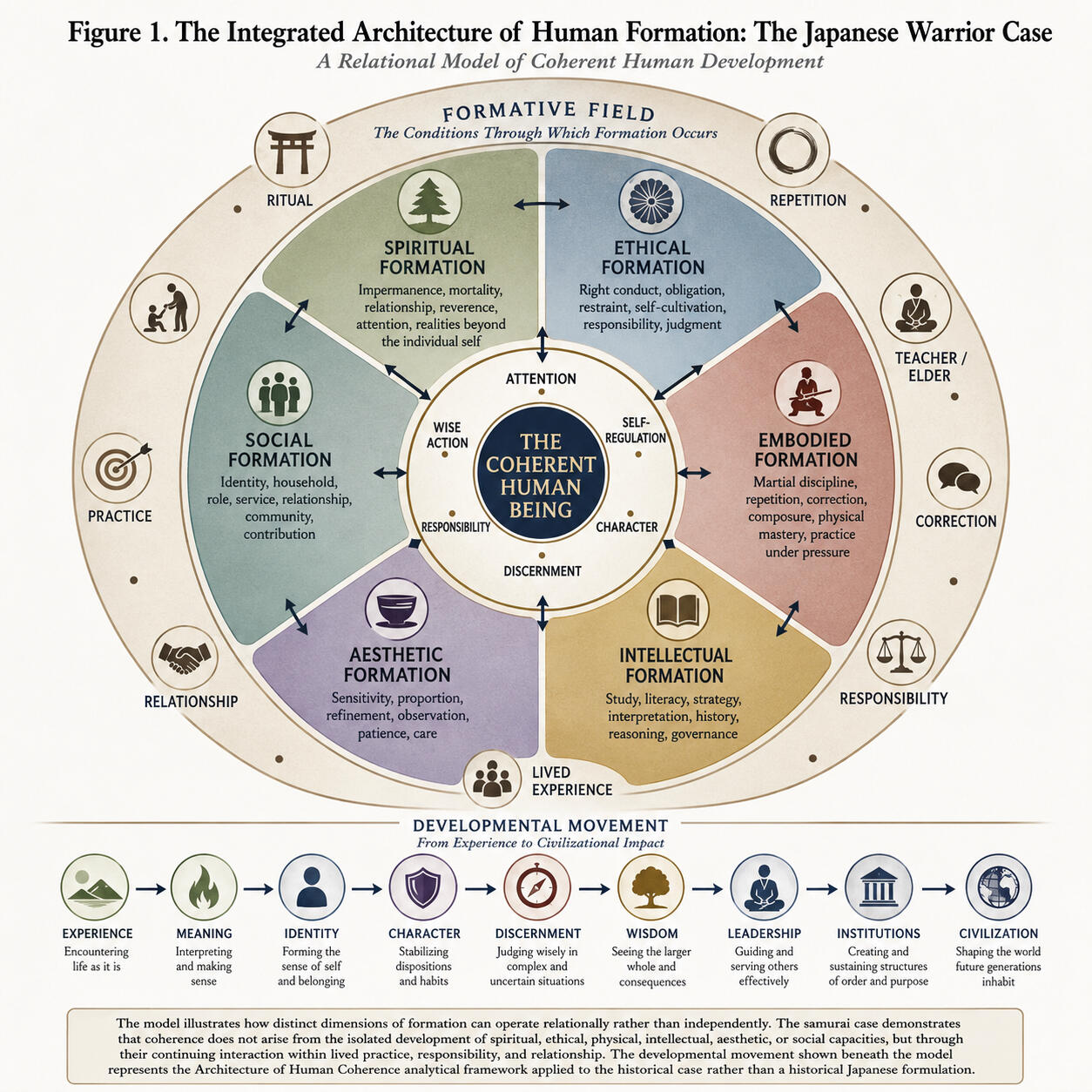
Traditional Japanese Civilization as an Architecture of Human Formation: A Case Study in the Formation of the Coherent Human Being - Research Paper XX: The Integrated Architecture of Human Formation: The Japanese Warrior Case
The model illustrates how distinct dimensions of formation can operate relationally rather than independently. The Japanese warrior case demonstrates that coherence does not arise from the isolated development of spiritual, ethical, embodied, intellectual, aesthetic, or social capacities, but through their continuing interaction within lived practice, responsibility, relationship, repetition, and correction. These dimensions inform and regulate one another: physical capability remains accountable to ethical restraint and discernment; ethical understanding is tested through embodied experience; spiritual orientation finds expression through conduct and relationship; intellectual development supports interpretation and judgment; aesthetic cultivation refines attention, sensitivity, proportion, and care; and social formation situates developed capacities within responsibility and contribution beyond the individual. The developmental movement represented beneath the model—Experience → Meaning → Identity → Character → Discernment → Wisdom → Leadership → Institutions → Civilization—reflects the Architecture of Human Coherence analytical framework applied to the historical case and should not be interpreted as a historical Japanese formulation.
For Research and collaboration, please connect. Let’s Have a dialogue.
Research & System Engagement
This work is actively being explored in relation to cognitive architecture, human–AI interaction, and generative systems.
What is presented here is not a completed system offered for passive consumption, but a living architecture that becomes fully visible only through engagement. The Architecture of Human Coherence is not intended to remain theoretical. It is designed to be explored, tested, refined, and extended in relation to real systems—whether those systems are technological, educational, organizational, or human.
At its core, this work is concerned with the continuity between perception, cognition, and action. Much of what currently exists in research and application treats these as separate domains, resulting in systems that are capable in isolation but fragmented in operation. What is being proposed here is a different orientation: one in which communication, language, pattern recognition, generative structure, identity, and embodiment are understood as aspects of a single, continuous process. When this continuity is recognized, the question is no longer how to optimize individual parts, but how to align the system as a whole so that it produces coherent and repeatable outcomes.
This has direct implications for how human beings interact with intelligent systems, how knowledge is structured and transmitted, how decisions are made, and how action is sustained over time. In the context of human–AI interaction, it raises the question of how machine systems can be aligned not only with human outputs, but with the underlying processes by which those outputs are formed. In education, it challenges the separation between learning and application by establishing a pathway in which knowledge is structured and embodied simultaneously. In leadership and decision-making, it provides a basis for coherence, where action is not reactive but aligned with an integrated internal structure. In generative design, it offers a way of understanding how complex systems emerge from simple relational principles, bridging cognition and creation.
What is required at this stage is not validation in the conventional sense, but exploration. The architecture must be placed into contact with other systems—technical, conceptual, and applied—in order to observe how it behaves, where it aligns, and where it reveals new possibilities. This is not a closed model; it is an open system designed for interaction.
Engagement with this work may take different forms. It may involve examining how the architecture maps onto existing cognitive or computational frameworks, exploring its implications for human–AI alignment, or applying its principles within educational or organizational contexts. It may also involve extending the model itself, identifying additional structures, or refining the relationships between its layers. In each case, the intention is not to impose a framework, but to work within it—to see what becomes visible when coherence is treated as a structural principle rather than an outcome.
If this work resonates at the level of structure—if it is recognized not simply as an idea, but as something that reflects an underlying order—then the next step is dialogue. Not as exchange of opinion, but as a means of bringing different domains into relation with one another. It is through this relation that the architecture becomes operational.
For direct engagement, inquiry, or collaboration, you are invited to initiate contact.
Areas of interest include:
cognitive architecture and intelligence systems
human–AI interaction and alignment
generative models of structure and meaning
education and knowledge system design
leadership and decision systems
This framework is designed for collaborative exploration, applied system development, and interdisciplinary research.
For direct engagement, inquiry, or collaboration: